Design And Synthesis of Heterocyclic Compounds for Antimicrobial Activity
DOI:
https://doi.org/10.64062/IJPCAT.Vol1.Issue3.1Keywords:
Heterocyclic compounds, antimicrobial activity, Pyrazole, MIC, In vivo study, Drug resistance, Structural characterization, Bacterial load, Thiazole, Pharmacological evaluation.Abstract
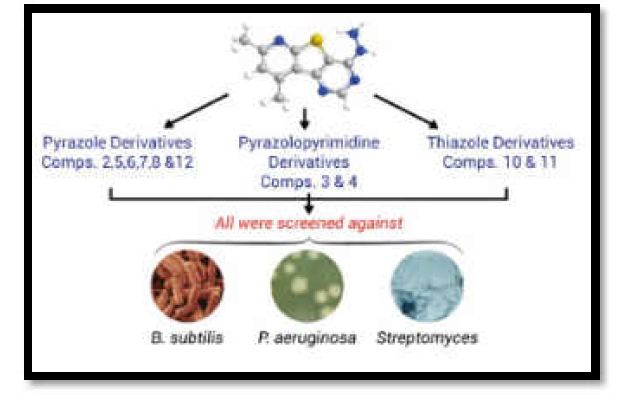
The increasing threat of antimicrobial resistance, there is an urgent need for new and efficacious therapeutic agents. This study describes the design, synthesis, and biological screening evaluation of four new series of heterocyclic compounds 1–4 with diverse substitution on thiazole, oxadiazole, pyrazole, and thiazolidinone scaffolds. These complexes were prepared by condensation reactions and characterised IR, ^1H NMR and mass spectrometry. Their antimicrobial potency was evaluated by minimum inhibitory concentration (MIC) tests and authenticated by in vivo approaches with BALB/c mice infected experimentally with E. coli, S. aureus, and P. aeruginosa. The pyrazole derivative HET-3 was the most potent of the synthesized molecules, whose MIC values were very similar to ciprofloxacin, with significant infection tissue bacterial load reduction. These results were confirmed statistically by one-way ANOVA analysis. The work points out the promising role of the substituted heterocyclic scaffolds, especially pyrazoles, as lead compounds for next generation antimicrobials, and focuses the need in for further pharmacokinetic and toxicity studies to progress these compounds up to clinical trial.