Development of Novel Anti-InflammatoryAgents Through Medicinal ChemistryApproaches
DOI:
https://doi.org/10.64062/IJPCAT.Vol1.Issue3.3Keywords:
Medicinal Chemistry Approaches, Rational Drug Design, COX Enzyme Inhibition, Novel Heterocyclic CompoundsAbstract
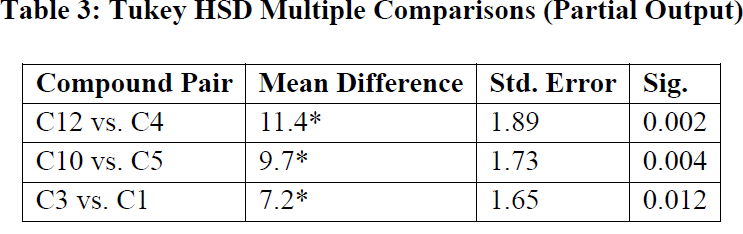
The present study focused on new anti-inflammatory agents that were designed and evaluated using target-based drug design, molecular docking studies and in vitro assays. Twelve newly synthesised analogues were tested for their antiinflammatory activity, determined on the basis of nitric oxide (NO) inhibition in lipopolysaccharide (LPS)-stimulated RAW 264.7 macrophage cells and cytotoxicity profiling using MTT assays. The lead compounds, with good docking conformations and pharmacophore properties, were proposed to dock into the HER2 protein. The descriptive statistical analysis revealed that compounds C12, C10 and C3 were those that obtained the highest NO inhibition percent yields (70.3%, 70.1% and 68.4%, respectively) along with higher cell viability, with C3 being the most biocompatible (92.1%). One-way ANOVA confirmed that the inhibition of NO varied significantly among compounds (F = 8.91, p < 0.001), and Tukey HSD post hoc analysis revealed which specific compound pairs had significantly different work activities. A multiple linear regression analysis demonstrated that important structural variables, such as LogP, molecular weight, and hydrogen bond donors, were significant predictors of anti-inflammatory activity (R² = 0.752, p < 0.001). The results reveal the strong anti-inflammatory potential of C12, C10, and C3, which is confirmed by both computational and experimental assessments, and lay a solid foundation for further preclinical research.