Recent Advances in Organic Chemistry: Emerging Strategies in Molecular Design, Green Synthesis, and Therapeutic Applications
DOI:
https://doi.org/10.64062/IJPCAT.Vol2.Issue5.8Keywords:
- organic chemistry; green chemistry; molecular design; click chemistry; bioorthogonal chemistry; PROTAC; photoredox catalysis; flow chemistry; therapeutic applications
Abstract
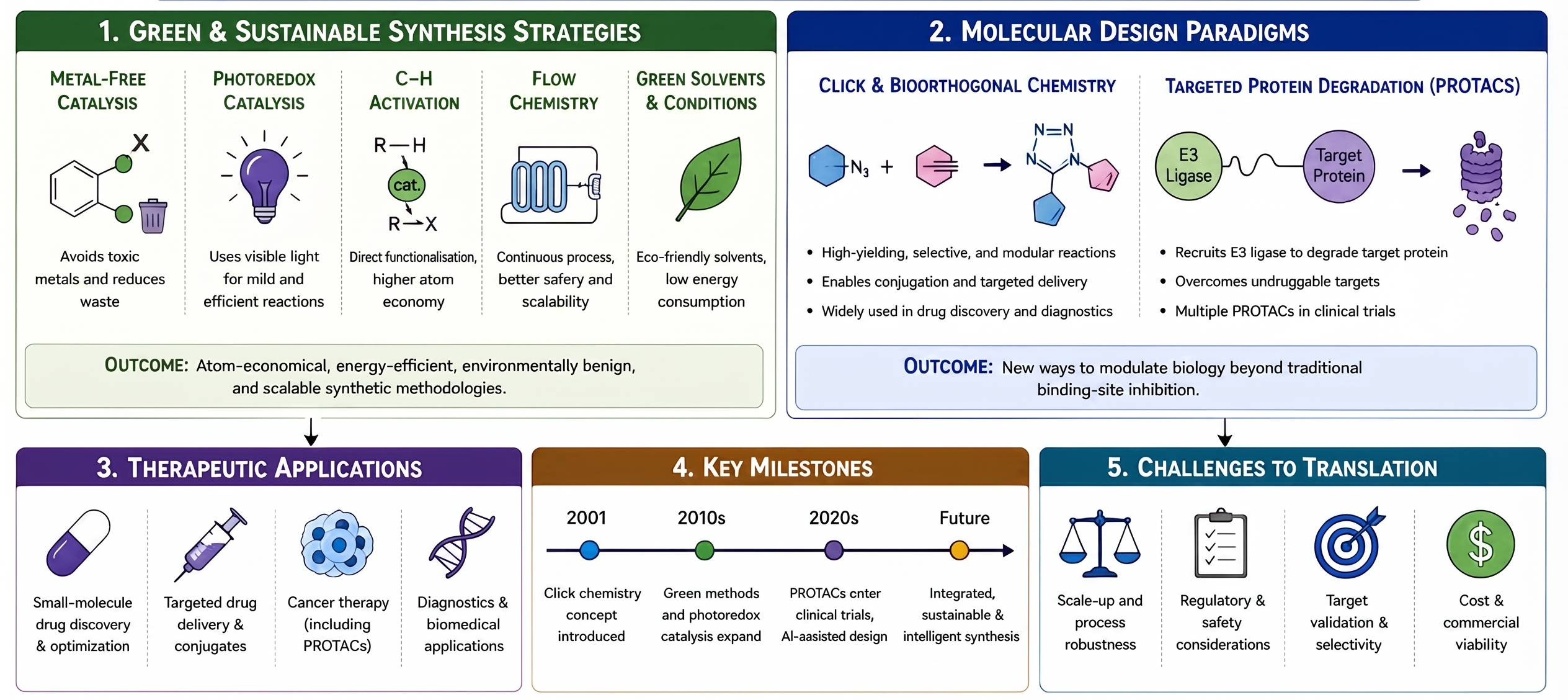
Organic chemistry continues to evolve rapidly at the intersection of synthetic methodology, molecular design, and pharmaceutical application. Over the past two decades, the discipline has moved decisively away from stoichiometric, metal- and solvent-intensive transformations toward catalytic, atom-economical, and energy-efficient strategies capable of constructing complex molecular architectures with minimal environmental burden. In parallel, a small number of conceptually transformative design paradigms most notably click and bioorthogonal chemistry, and, more recently, targeted protein degradation using proteolysis-targeting chimeras (PROTACs) have reshaped how chemists approach the construction of bioactive molecules, shifting emphasis from occupying a binding site to engineering a desired biological outcome through selective covalent linkage or induced protein degradation. This review surveys these two convergent threads of modern organic chemistry: emerging strategies for green and sustainable synthesis, including metal-free and photoredox catalysis, C–H activation, and flow chemistry; and molecular design paradigms built on click and bioorthogonal reactions and targeted protein degradation technology. We examine how these methodologies have been translated into pharmaceutical and biomedical applications, from large-scale process synthesis of active pharmaceutical ingredients to click-chemistry-enabled construction of PROTAC degraders now advancing through clinical trials, and we critically assess the methodological, scale-up, and translational challenges that continue to constrain this field. We conclude that the convergence of sustainable synthetic methodology with rationally engineered molecular design represents the most productive current trajectory in organic chemistry, and that continued progress will depend on closing the gap between laboratory-scale innovation and robust, reproducible translation to process and clinical scale.
References
Downloads
Published
Issue
Section
License
Copyright (c) 2026 This is an Open Access article distributed under the terms of the Creative Commons Attribution (CC BY NC), which permits unrestricted use, distribution, and reproduction in any medium, as long as the original authors and source are cited. No permission is required from the authors or the publishers. (https://creativecommons.org/licenses/by-nc/4.0/)

This work is licensed under a Creative Commons Attribution 4.0 International License.