Quantum Dots in Materia Medica: Emerging Tools for Bioimaging and Targeted Drug Delivery
DOI:
https://doi.org/10.64062/IJPCAT.Vol2.Issue1.5Keywords:
- Quantum Dots, Nanomedicine, Targeted Drug Delivery, Bioimaging, Theranostics, Fluorescence, Nanocarriers, Photodynamic Therapy, Carbon Quantum Dots, Biodistribution, Pharmacokinetics, Precision Medicine, Stimuli-Responsive Delivery, Metal-Free Nanoparticles
Abstract
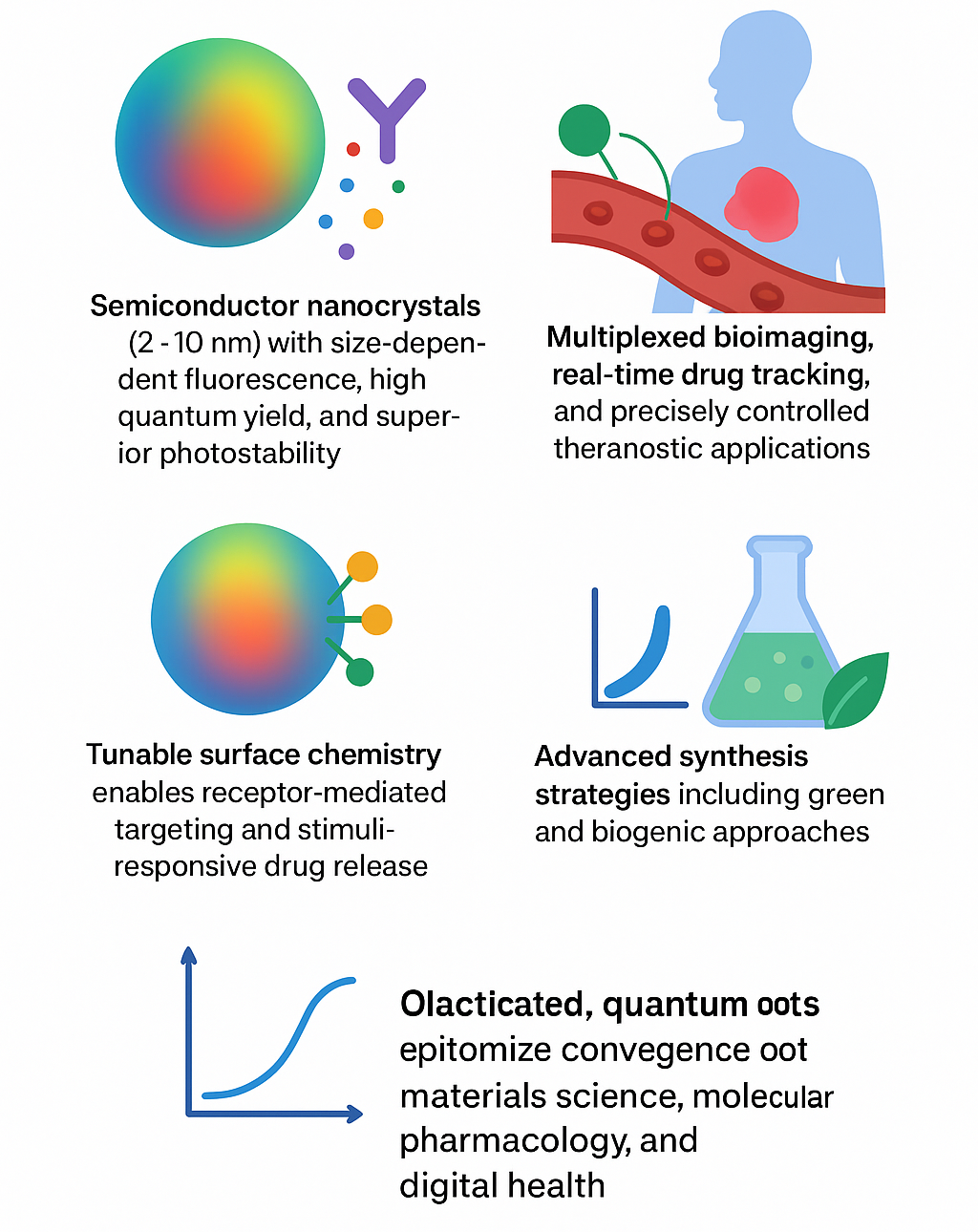
Quantum dots (QDs) have revolutionized biomedical sciences by offering exceptional optical, electronic, and chemical versatility for simultaneous imaging, diagnostics, and targeted drug delivery. These semiconductor nanocrystals (2–10 nm), with their size-dependent fluorescence, high quantum yield, and superior photostability compared to conventional organic dyes, enable multiplexed bioimaging, real-time drug tracking, and precisely controlled theranostic applications. The tunable surface chemistry of QDs allows functional modification with targeting ligands, therapeutic agents, and biocompatible coatings, facilitating receptor-mediated targeting and stimuli-responsive drug release across diverse disease contexts. Advanced synthesis strategies—including colloidal, hydrothermal, and green (biogenic) methods—have enabled the production of eco-friendly alternatives to heavy-metal-based QDs, such as carbon quantum dots, graphene QDs, and silicon-based systems, which maintain superior optical performance while minimizing cytotoxicity concerns. Functionally, QDs act as multifunctional nanocarriers via mechanisms including fluorescence resonance energy transfer (FRET), pH-responsive release, enzyme-triggered activation, and light-mediated delivery. Pharmacokinetically, QD biodistribution is governed by size, surface charge, and coating, with optimal formulations achieving prolonged circulation and tissue-specific accumulation. Clinical successes in tumor imaging, gene delivery tracking, and theranostic platforms underscore their translational potential. However, challenges including long-term toxicity from heavy metals, physicochemical stability in biological fluids, batch-to-batch reproducibility, and regulatory standardization remain critical barriers. The integration of artificial intelligence for imaging interpretation and predictive pharmacokinetic modeling, alongside advances in biodegradable and personalized QD engineering, represents the next frontier. Collectively, quantum dots epitomize the convergence of materials science, molecular pharmacology, and digital health—transforming precision diagnostics and therapy into seamlessly integrated, patient-centric nanomedicines.
References
Downloads
Published
Issue
Section
License
Copyright (c) 2026 This is an Open Access article distributed under the terms of the Creative Commons Attribution (CC BY NC), which permits unrestricted use, distribution, and reproduction in any medium, as long as the original authors and source are cited. No permission is required from the authors or the publishers. (https://creativecommons.org/licenses/by-nc/4.0/)

This work is licensed under a Creative Commons Attribution 4.0 International License.