Recent Trends in Chromatographic Techniques for Pharmaceutical Analysis: A Review
DOI:
https://doi.org/10.64062/IJPCAT.Vol2.Issue2.5Keywords:
- Chromatography; Pharmaceutical Analysis; HPLC; UPLC; Animal-Based Studies; Pharmacokinetics; Drug Metabolism; Toxicology
Abstract
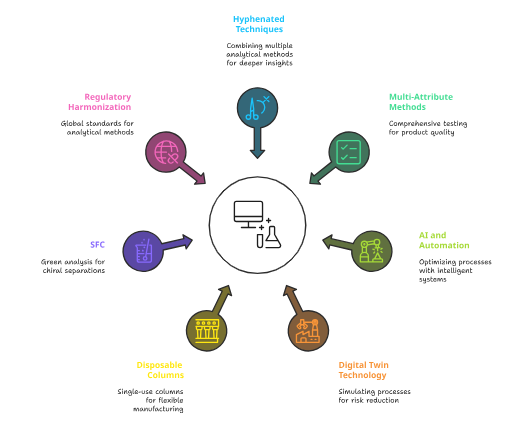
Chromatography is a critical instrument in pharmaceutical analysis, as it allows the successful separation, identification, and determination of complex drug formulations and biological matrices. Over recent years, large improvements in chromatographic technology, such as High-Performance Liquid Chromatography (HPLC), UPLC, Gas Chromatography (GC), Supercritical Fluid Chromatography (SFC) and other hyphenated techniques, have made major improvements in the sensitivity and speed of analysis and accuracy. This review makes a concise review of the recent trends in chromatographic techniques, alongside a special focus on their use in animal studies pertaining to pharmacokinetics, toxicology and drug metabolism. The literature has been systematically evaluated to assess the methodological developments, technological innovations, and performance of analysis. The results emphasize that high-throughput, high-sensitivity, and environmentally friendly chromatographic methods have become more and more important in contemporary pharmaceutical research.
References
Downloads
Published
Issue
Section
License
Copyright (c) 2026 This is an Open Access article distributed under the terms of the Creative Commons Attribution (CC BY NC), which permits unrestricted use, distribution, and reproduction in any medium, as long as the original authors and source are cited. No permission is required from the authors or the publishers. (https://creativecommons.org/licenses/by-nc/4.0/)

This work is licensed under a Creative Commons Attribution 4.0 International License.