Click Chemistry in Peptide-Based Drug Discovery: Recent Advances, Emerging Applications, and Future Perspectives in Medicinal Chemistry
DOI:
https://doi.org/10.64062/IJPCAT.Vol2.Issue4.1Keywords:
- Click chemistry; Peptide therapeutics; Triazole chemistry; Medicinal chemistry; Drug discovery
Abstract
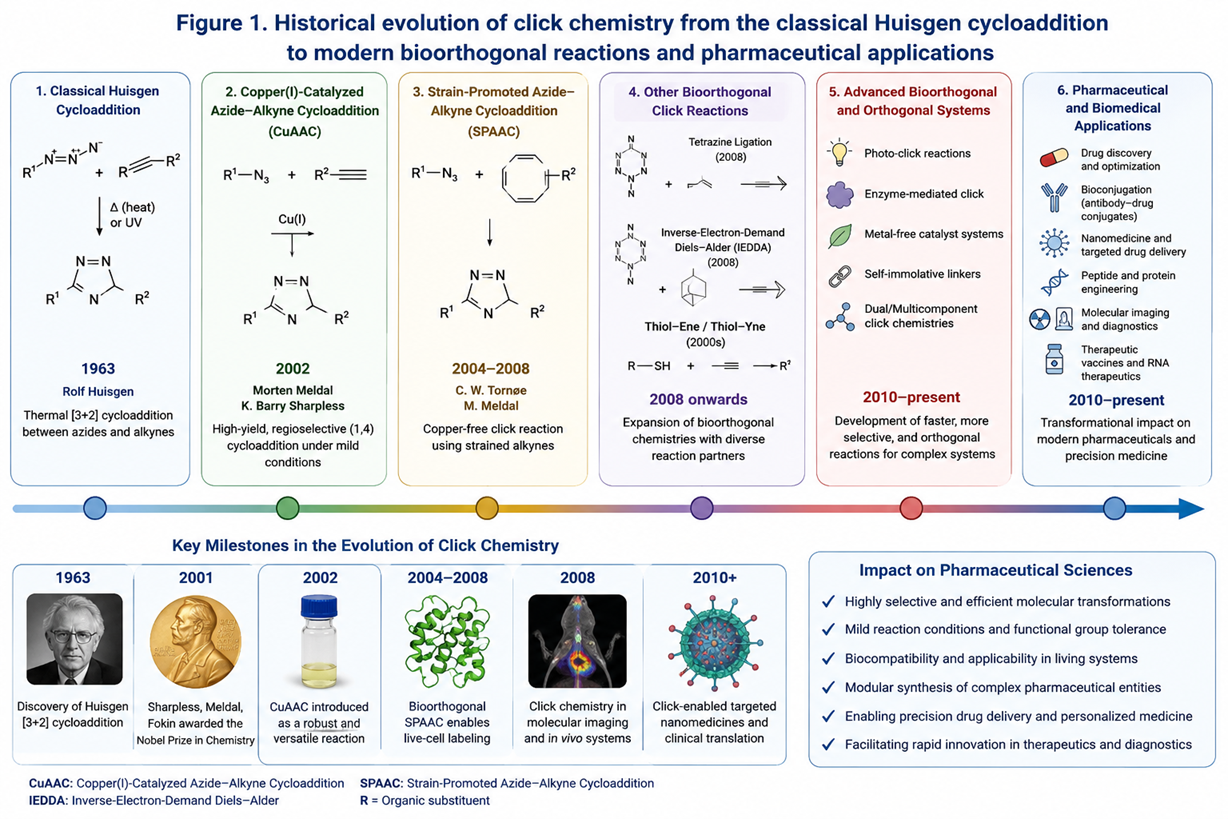
Click chemistry has fundamentally transformed modern medicinal chemistry by providing a versatile, high-yielding, and chemoselective strategy for assembling complex molecular architectures under mild reaction conditions. Since its introduction, this synthetic approach has become an indispensable tool for the rapid construction of biologically active molecules, particularly in peptide-based drug discovery, where structural precision, metabolic stability, and synthetic efficiency are critical determinants of therapeutic success. Among the various click reactions, copper (I)-catalyzed azide-alkyne cycloaddition (CuAAC) has gained widespread recognition because of its exceptional regioselectivity, functional-group tolerance, and ability to generate stable 1,2,3-triazole linkages that effectively mimic peptide and amide bonds. These attributes have significantly expanded opportunities for developing peptide therapeutics with improved pharmacological performance and enhanced resistance to enzymatic degradation. This review critically examines the scientific evolution of click chemistry and its expanding role in peptide engineering, drug design, and pharmaceutical innovation. Particular emphasis is placed on the mechanistic basis of major click reactions, triazole-mediated peptide modification, peptide cyclization, stapling strategies, and the development of therapeutics for cancer, infectious diseases, inflammatory disorders, and other clinically significant conditions. Recent advances in bio-orthogonal chemistry, targeted drug delivery, molecular imaging, Nano medicine, and bio molecular conjugation are also discussed to illustrate the broad translational impact of click chemistry across contemporary biomedical research. In addition, the review highlights the emerging convergence of click chemistry with artificial intelligence, machine learning, and computational drug discovery, emphasizing how predictive molecular design, reaction optimization, and virtual screening are reshaping medicinal chemistry workflows. Current limitations, including catalyst-associated toxicity, scalability, manufacturing challenges, and regulatory considerations, are critically evaluated alongside promising solutions that support sustainable and clinically translatable pharmaceutical development. By integrating foundational concepts with recent scientific advances, this review provides a comprehensive perspective on the present status of click chemistry and outlines future directions for its application in peptide therapeutics, precision medicine, and next-generation drug discovery.
References
Downloads
Published
Issue
Section
License
Copyright (c) 2026 This is an Open Access article distributed under the terms of the Creative Commons Attribution (CC BY NC), which permits unrestricted use, distribution, and reproduction in any medium, as long as the original authors and source are cited. No permission is required from the authors or the publishers. (https://creativecommons.org/licenses/by-nc/4.0/)

This work is licensed under a Creative Commons Attribution 4.0 International License.