Molecular Docking and Simulation Studies in Drug Discovery: Principles, Applications, and Current Limitations
DOI:
https://doi.org/10.64062/IJPCAT.Vol2.Issue4.2Keywords:
- Molecular Docking, Molecular Dynamics Simulations, Structure-Based Drug Design, Scoring Functions, Binding Affinity, ADMET Prediction, Computer-Aided Drug Design, Drug Discovery
Abstract
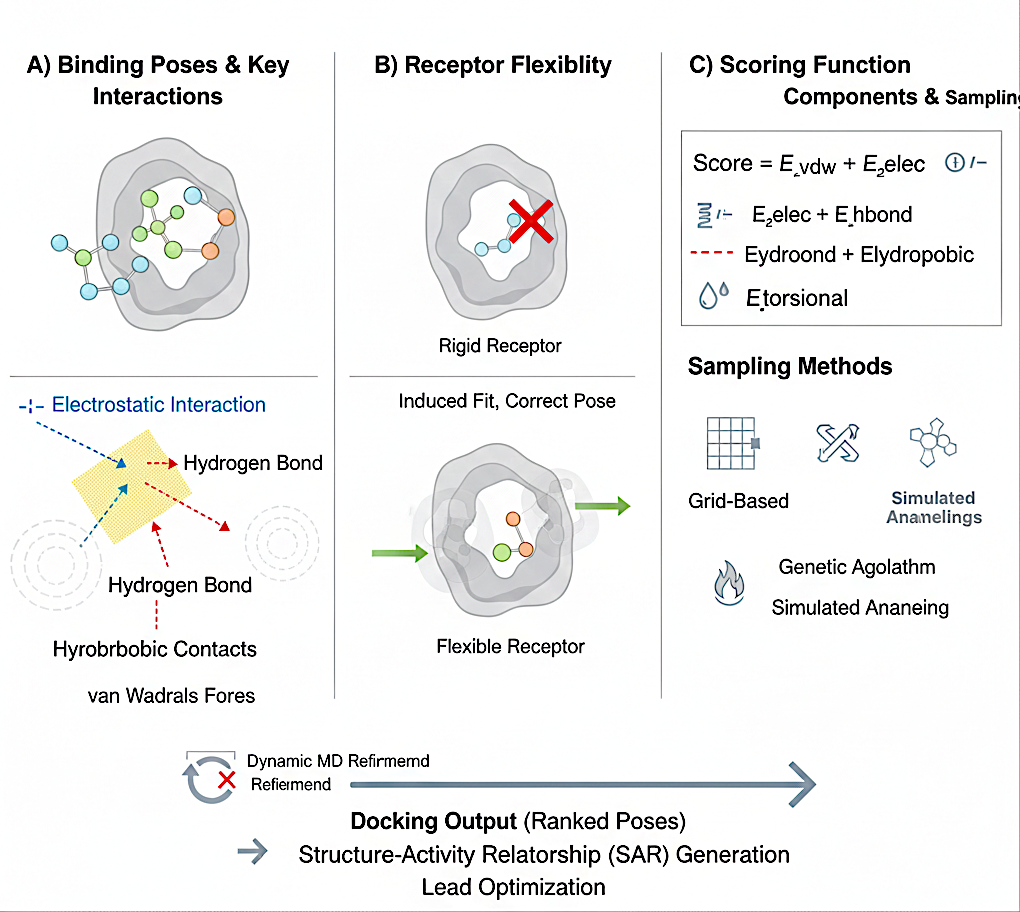
Molecular docking and molecular dynamics (MD) simulations have become indispensable tools in modern drug discovery, enabling researchers to accelerate the identification and optimisation of therapeutic compounds. This comprehensive review examines the fundamental principles underlying these computational approaches, their diverse applications in pharmaceutical development, and the significant limitations that currently constrain their predictive accuracy and applicability. We discuss structure-based drug design methodologies, scoring functions, binding-affinity prediction, conformational sampling strategies, and the integration of artificial intelligence into computational drug discovery. Furthermore, we address critical challenges, including protein flexibility representation, ADMET (Absorption, Distribution, Metabolism, Excretion, and Toxicity) prediction accuracy, and the persistent discrepancy between in silico predictions and experimental validation. Recent advances in hardware acceleration, force-field development, and machine learning are reshaping the landscape of computational drug discovery. This review synthesises current knowledge and highlights future opportunities for enhancing the reliability and efficiency of molecular docking and simulation studies in pharmaceutical research.
References
Downloads
Published
Issue
Section
License
Copyright (c) 2026 This is an Open Access article distributed under the terms of the Creative Commons Attribution (CC BY NC), which permits unrestricted use, distribution, and reproduction in any medium, as long as the original authors and source are cited. No permission is required from the authors or the publishers. (https://creativecommons.org/licenses/by-nc/4.0/)

This work is licensed under a Creative Commons Attribution 4.0 International License.