Structure-Based Molecular Docking Study of Curcuma longa Phytoconstituents in Rheumatoid Arthritis Therapy
DOI:
https://doi.org/10.64062/IJPCAT.Vol2.Issue4.6Keywords:
- Curcuma longa; Rheumatoid arthritis; Molecular docking; Curcumin; Anti-inflammatory activity
Abstract
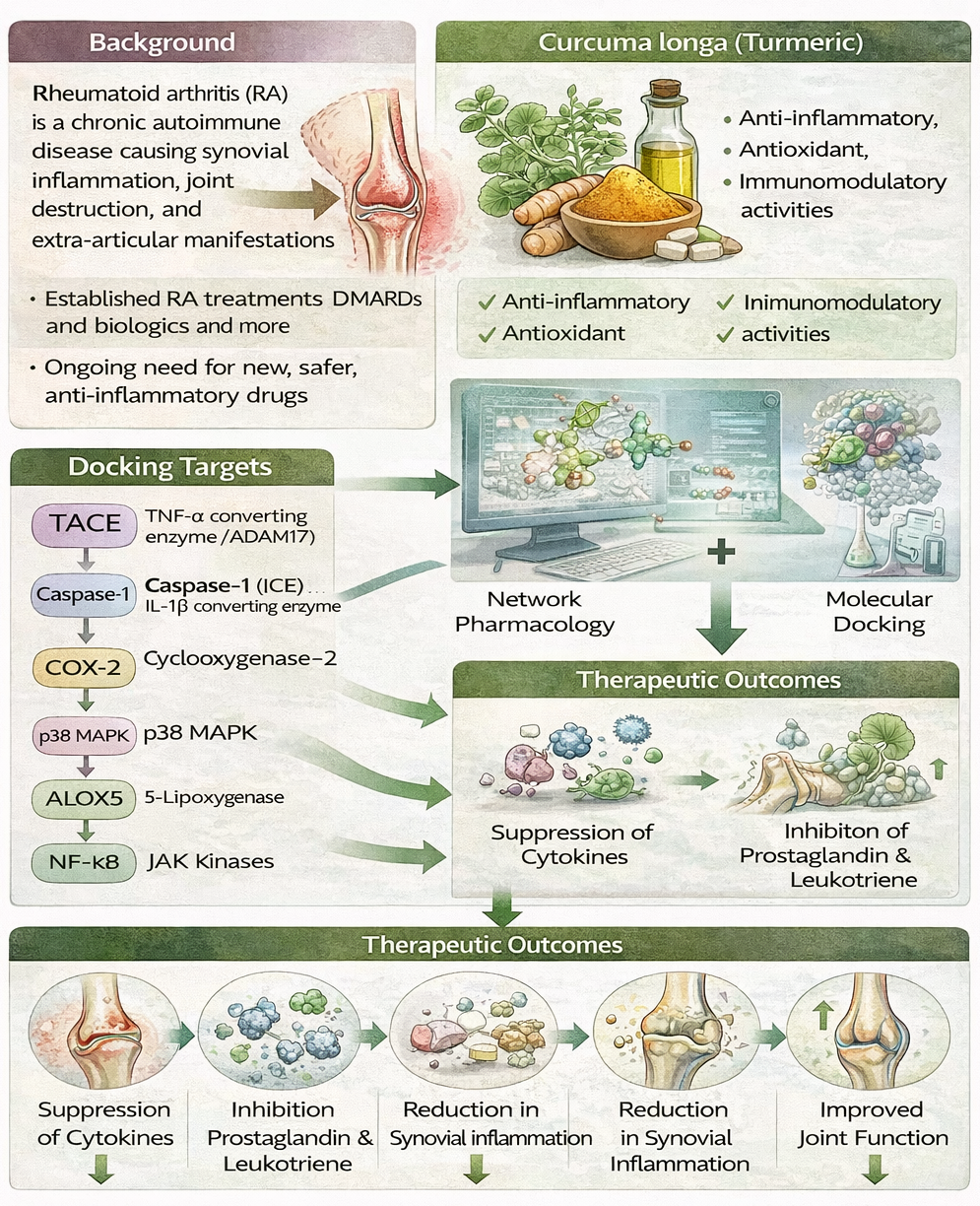
Rheumatoid arthritis (RA) is a chronic, systemic autoimmune disease that manifests as synovial inflammation and subsequent erosive joint destruction coupled with extra-articular manifestations, which lead to considerable disability and decreased quality of life. Established disease-modifying antirheumatic drugs (DMARDs) and biological agents that target either cytokines or intracellular kinases have revolutionized the management of RA, but they are not without their drawbacks, including high costs, incomplete response in a subset of patients, and safety concerns such as increased risk for infection or malignancy. As a result, there is an ongoing quest to discover new, less toxic anti-inflammatory and immunomodulatory drugs, including those from medicinal plants. Curcuma longa L. (turmeric) has been used for centuries in traditional medicine to treat inflammatory and musculoskeletal disorders. Its main polyphenolic component, curcumin, along with closely related curcuminoids and other phytoconstituents, has shown powerful anti-inflammatory, antioxidant, and immunomodulatory actions that are important in RA pathogenesis. Utilizing molecular docking, which is commonly combined with molecular dynamics (MD), pharmacophore modeling, and ADMET prediction approaches, enables a systematic evaluation of C. longa phytochemicals across various stages and numerous RA-related molecular targets, including cytokines, enzymes, kinases, and transcription factors. This review compiles existing data on structure-based docking studies of C. longa phytoconstituents for RA treatment. It begins by summarizing RA pathophysiology and the pharmacology of C. longa and its major constituents. It then describes docking studies for curcumin and analogues with key targets in RA such as tumor necrosis factor-α (TNF‑α) converting enzyme (TACE), interleukin‑1β converting enzyme (ICE/caspase‑1), cyclooxygenase-2 (COX-2), p38 MAP kinase, and arachidonate 5-lipoxygenase (ALOX5) along the pharmacology network derived target. The report focuses on the consistency of docking predictions with in vitro/in vivo anti-RA data, scrutinizes ADMET and drug-likeness profiles, and covers the limitations of current iterative in silico work. Overall, the aforementioned existing docking and computational studies lay a foundation for concluding that curcumin and other structurally similar C. longa phytochemicals can bind with suitable affinities to several proteins relevant to RA pertaining to their known therapeutic effects on cytokines processing, eicosanoid synthesis, NF‑κB and MAPK signaling pathways, as well as leukotriene biosynthesis of which reaffirms its structure-function relationship with regard to its established multiphasic anti-inflammatory and disease-modifying capacities. Translation of these findings to benefit patients presents integrated challenges of standardized phytochemistry, rigorous docking and MD protocols, experimental validation of target engagement, delivery systems and carefully designed clinical trials.
References
Downloads
Published
Issue
Section
License
Copyright (c) 2025 This is an Open Access article distributed under the terms of the Creative Commons Attribution (CC BY NC), which permits unrestricted use, distribution, and reproduction in any medium, as long as the original authors and source are cited. No permission is required from the authors or the publishers. (https://creativecommons.org/licenses/by-nc/4.0/)

This work is licensed under a Creative Commons Attribution 4.0 International License.