Advanced Analytical Chemistry: Emerging Technologies for Biomarker Analysis, Drug Quantification, and Clinical Diagnostics
DOI:
https://doi.org/10.64062/Keywords:
- LC-MS/MS; biomarker discovery; therapeutic drug monitoring; CRISPR diagnostics; liquid biopsy; circulating tumor DNA; point-of-care testing; artificial intelligence
Abstract
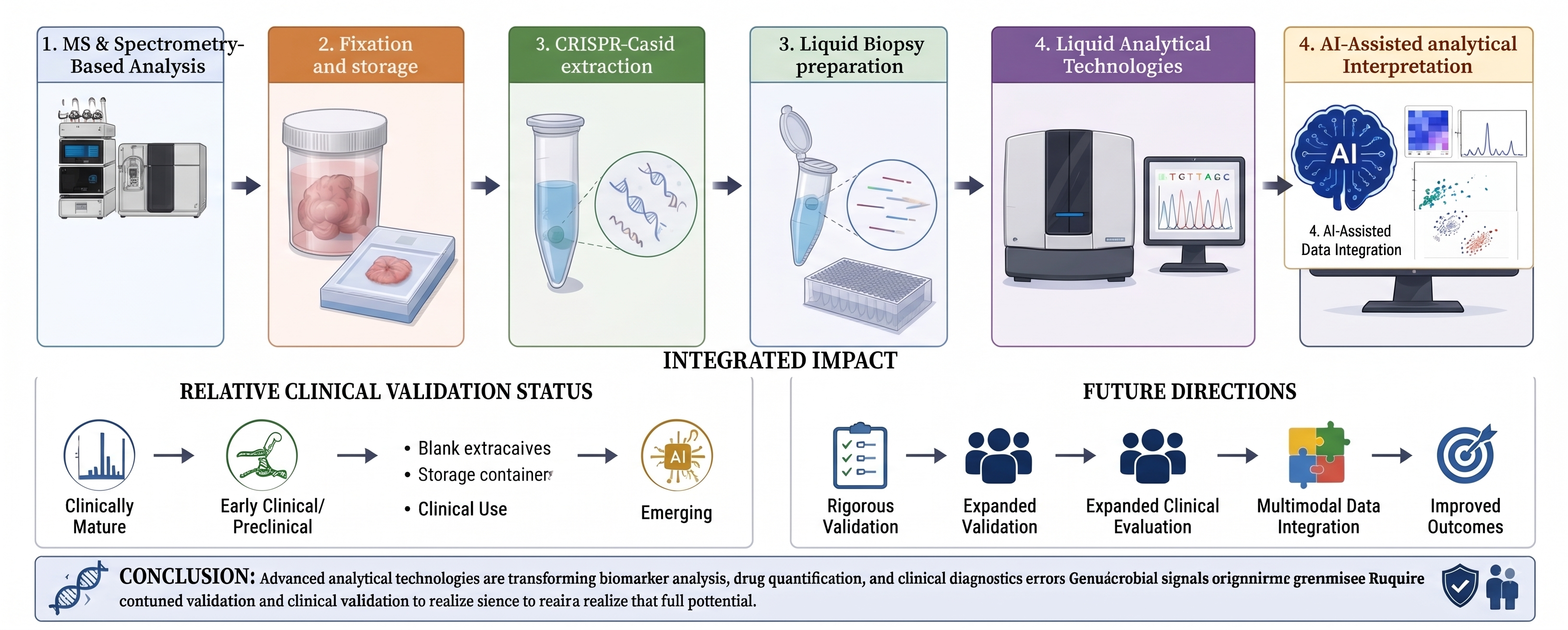
Background: Clinical diagnostics and pharmaceutical bioanalysis are undergoing rapid technological transformation, driven by advances in mass spectrometry, molecular and CRISPR-based diagnostic platforms, liquid biopsy analytes, and artificial intelligence (AI)-assisted data interpretation. These emerging technologies promise faster, more sensitive, and more accessible biomarker analysis and drug quantification, but exhibit markedly different degrees of analytical validation and clinical translation. Objective: To synthesize recent advances in mass spectrometry-based bioanalysis, CRISPR-based molecular diagnostics, liquid biopsy technologies, and AI-assisted analytical interpretation, with explicit, platform-specific grading of clinical validation and translational status, and to identify priority directions for continued development. Methods: A structured, non-systematic literature search of PubMed, Scopus, Web of Science, and Google Scholar (inception–June 2026) was conducted using combinations of technology-, application-, and validation-specific search terms, detailed in Section 2. Results: Liquid chromatography-tandem mass spectrometry (LC-MS/MS) remains the most clinically mature and routinely validated platform reviewed, underpinning therapeutic drug monitoring and targeted biomarker quantification with detection limits reaching the low picogram-per-milliliter range. Circulating tumor DNA (ctDNA)-based liquid biopsy has achieved clinical use for selected companion-diagnostic and treatment-monitoring indications in specific cancers, supported by next-generation sequencing and droplet digital PCR. CRISPR-based point-of-care diagnostic platforms (leveraging Cas12/Cas13 effector proteins) show strong analytical performance in a rapidly growing preclinical and early-clinical literature, but a 2024 systematic review of 44 relevant studies identified no CRISPR-based point-of-care diagnostic with documented widespread clinical deployment, though select platforms have progressed into clinical trials. Artificial intelligence is increasingly embedded across all platforms reviewed, from mass spectral interpretation to multimodal liquid biopsy data fusion, but itself requires platform-specific analytical and clinical validation before diagnostic deployment. Conclusion: Analytical chemistry continues to deliver transformative tools for biomarker analysis, drug quantification, and clinical diagnostics, with translational maturity varying markedly by platform. Continued progress will depend on rigorous, platform-specific validation; expanded clinical-stage evaluation of CRISPR-based and multimodal liquid biopsy platforms; and careful, appropriately validated integration of AI/ML tools rather than uncritical adoption on the basis of analytical promise alone.
References
Downloads
Published
Issue
Section
License
Copyright (c) 2026 This is an Open Access article distributed under the terms of the Creative Commons Attribution (CC BY NC), which permits unrestricted use, distribution, and reproduction in any medium, as long as the original authors and source are cited. No permission is required from the authors or the publishers. (https://creativecommons.org/licenses/by-nc/4.0/)

This work is licensed under a Creative Commons Attribution 4.0 International License.