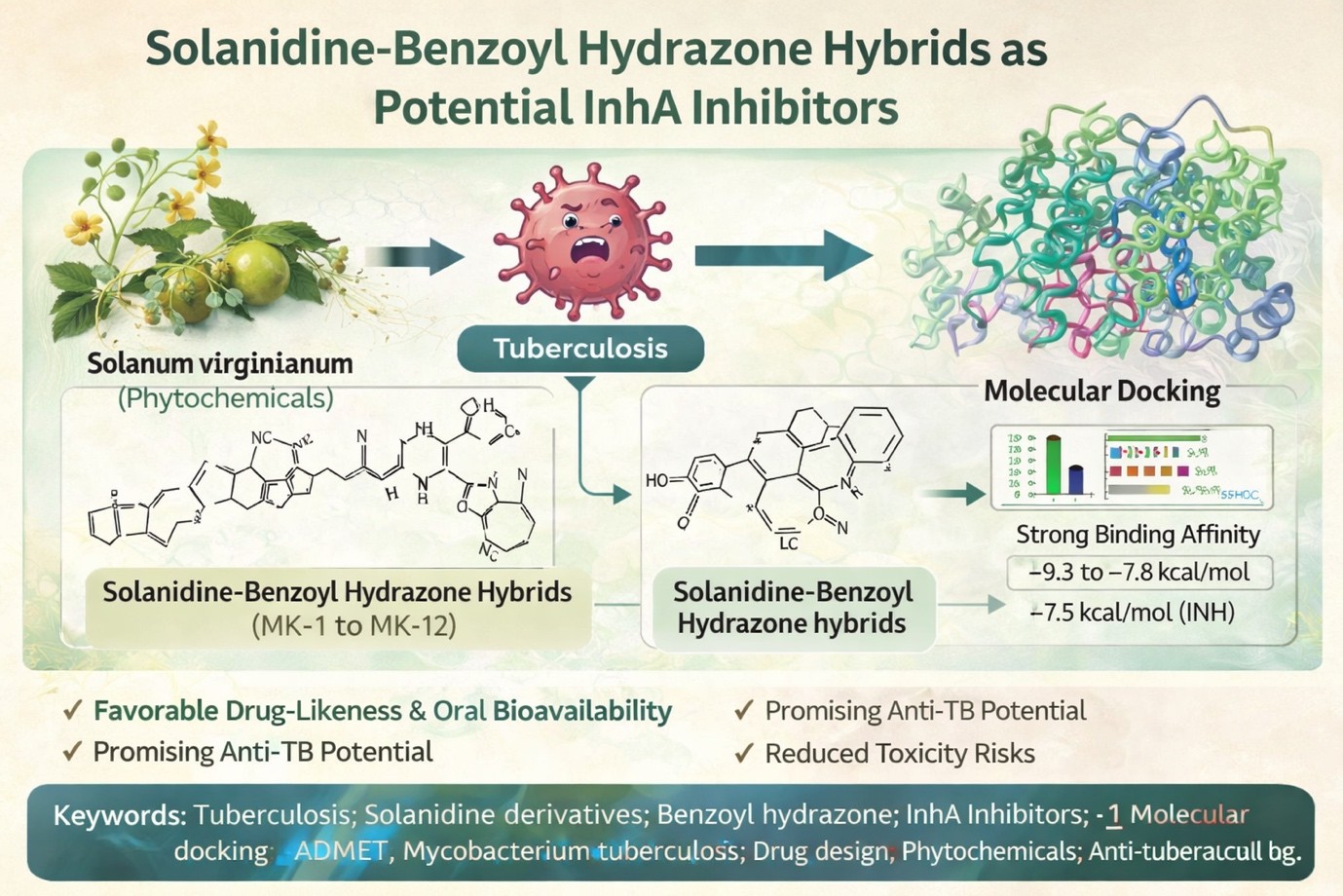
Design, Synthesis, and Molecular Docking Studies of Novel Solanidine-Benzoyl Hydrazone Hybrids as Potential InhA Inhibitors
DOI:
https://doi.org/10.64062/Keywords:
- Tuberculosis; Solanidine derivatives; Benzoyl hydrazone; InhA inhibitors; Molecular docking; ADMET; Mycobacterium tuberculosis; Drug design; Phytochemicals; Anti-tubercular agents
Abstract
Tuberculosis (TB) remains a major global health concern due to increasing drug resistance, poor bioavailability of first-line drugs, and associated hepatotoxicity. This study reports the design, synthesis, and molecular docking evaluation of novel solanidine–benzoyl hydrazone hybrid derivatives (MK-1 to MK-12) as potential inhibitors of the enoyl-acyl carrier protein reductase (InhA) enzyme of Mycobacterium tuberculosis. The compounds were synthesized via a multi-step process involving Vilsmeier–Haack formylation, Schiff base formation, and cyclization, and were characterized using FTIR, TLC, and mass spectrometry. Molecular docking studies using AutoDock Vina against the InhA enzyme (PDB ID: 5JFO) revealed strong binding affinities (−9.3 to −7.8 kcal/mol), exceeding that of the standard drug isoniazid (−7.5 kcal/mol). ADMET prediction using SwissADME demonstrated favorable drug-likeness, good oral bioavailability, and compliance with Lipinski’s rule of five for most compounds. Toxicity profiling indicated moderate hepatotoxicity, neurotoxicity, and nephrotoxicity risks, while cardiotoxicity remained negligible. Phytochemical screening of Solanum virginianum confirmed the presence of bioactive constituents such as alkaloids, flavonoids, saponins, and glycosides, supporting its pharmacological relevance. The findings suggest that these hybrid derivatives exhibit promising anti-tubercular potential and may serve as effective adjuncts to existing therapies with improved efficacy and reduced toxicity.
References
Downloads
Published
Issue
Section
License
Copyright (c) 2026 This is an Open Access article distributed under the terms of the Creative Commons Attribution (CC BY NC), which permits unrestricted use, distribution, and reproduction in any medium, as long as the original authors and source are cited. No permission is required from the authors or the publishers. (https://creativecommons.org/licenses/by-nc/4.0/)

This work is licensed under a Creative Commons Attribution 4.0 International License.