Medicinal Chemistry in Recent Drug Discovery: Rational Design, Structure–Activity Relationships, and Future Perspectives
DOI:
https://doi.org/10.64062/Keywords:
- medicinal chemistry; rational drug design; structure–activity relationship; structure-based drug design; fragment-based drug discovery; QSAR; ADMET; PROTAC; covalent inhibitors; artificial intelligence
Abstract
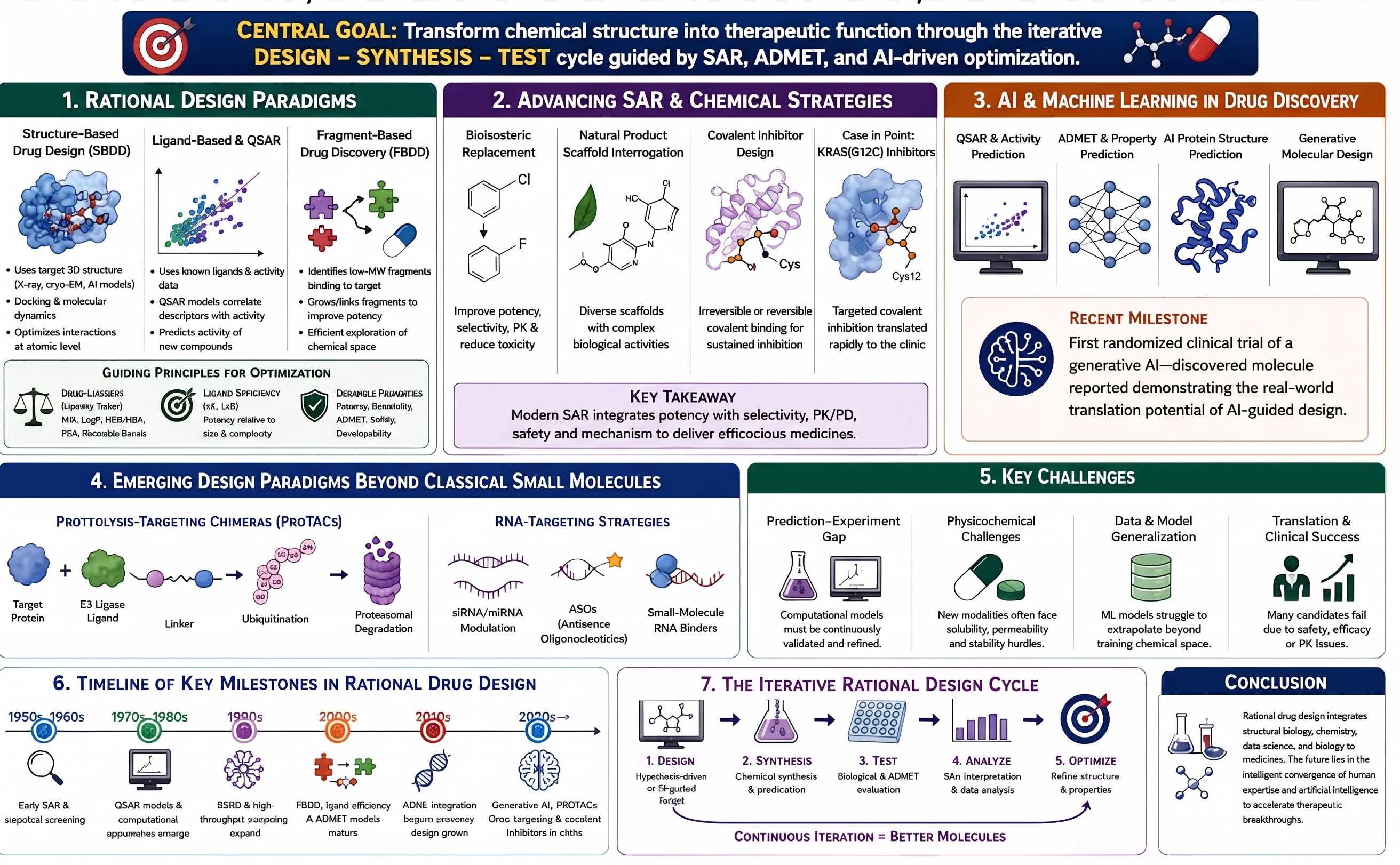
Medicinal chemistry occupies the interface between chemical structure and biological function, and its central working method the iterative design–synthesis–test cycle guided by structure–activity relationships (SAR) has remained conceptually stable even as the tools available to execute it have been transformed. This review surveys the current state of rational drug design across three converging strands. First, we examine the principal design paradigms in use today: structure-based drug design guided by target crystal or predicted structures, ligand-based and quantitative structure–activity relationship (QSAR) approaches, and fragment-based drug discovery, alongside the quantitative drug-likeness and ligand-efficiency criteria that guide compound optimisation. Second, we survey how SAR analysis has been extended beyond classical single-target potency optimisation to encompass bioisosteric replacement, natural product scaffold interrogation, and the deliberate, mechanism-guided design of targeted covalent inhibitors, illustrated by the rapid clinical translation of covalent KRAS(G12C) inhibitors. Third, we examine the growing integration of artificial intelligence and machine learning across this pipeline, from QSAR and absorption-distribution-metabolism-excretion-toxicity (ADMET) property prediction through to AI-guided protein structure prediction and generative molecular design, including a recently reported randomised clinical trial of a generative-AI-discovered candidate. We further discuss emerging design paradigms that extend medicinal chemistry beyond classical small-molecule occupancy, including proteolysis-targeting chimeras (PROTACs) and small-molecule RNA-targeting strategies. Finally, we critically examine the methodological and translational challenges that continue to constrain the field including the persistent gap between computational prediction and experimental validation, the physicochemical property challenges posed by newer modalities, and the difficulty of generalising machine learning models beyond their training data and outline priority directions for the continued evolution of rational drug design.
References
Downloads
Published
Issue
Section
License
Copyright (c) 2026 This is an Open Access article distributed under the terms of the Creative Commons Attribution (CC BY NC), which permits unrestricted use, distribution, and reproduction in any medium, as long as the original authors and source are cited. No permission is required from the authors or the publishers. (https://creativecommons.org/licenses/by-nc/4.0/)

This work is licensed under a Creative Commons Attribution 4.0 International License.